Showing posts with label ERF. Show all posts

Sunday, 28 October 2018

1930s AERIAL VIEWS OF MIDDLEWICH


by Dave Roberts

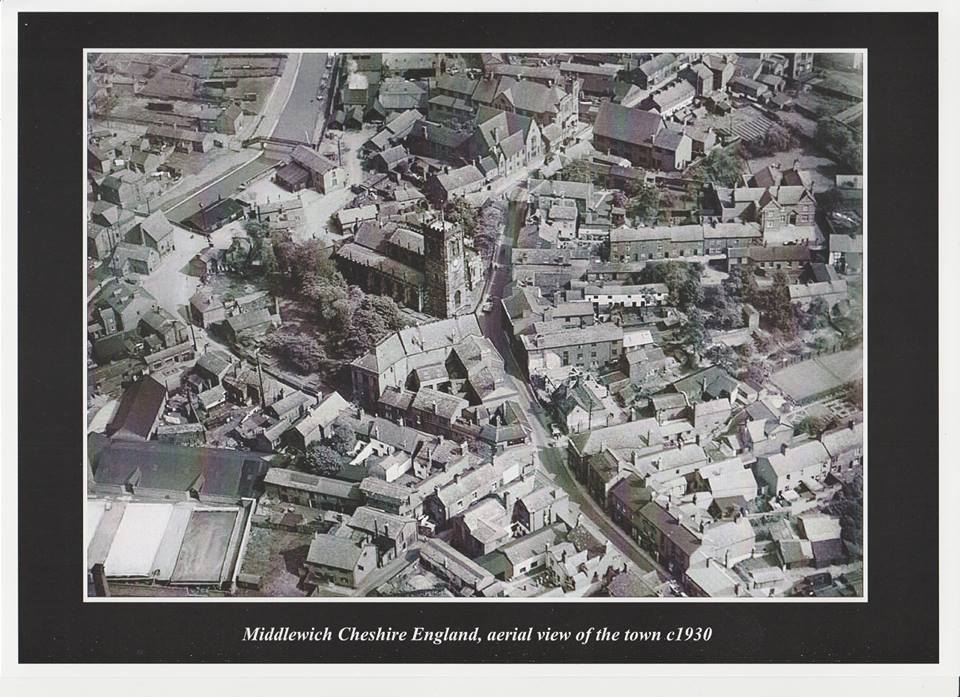
We're grateful to Dave Griffiths who contacted us in September this year with the news that a set of four aerial views of 'Middlewich in the 1930s' was being offered for sale on Ebay.

Dave couldn't resist the temptation, and bought all four photos.

He's kindly sent us copies of them so that we can show them to a wider audience and give people just a taste of how Middlewich looked no less than eighty-eight years ago (or more).

We've already encountered a couple of these photos over the years, but never before in such high quality.

English Heritage's Britain From Above website*, which features aerial photos of towns and villages all over the country, carries copies of at least two of them and, a few years ago appealed for people to contact them with information as to what they showed. 

Which is what the Middlewich Diary did in respect of the Webb's Lane/Finney's Lane view (see below).

You'll note that these views are all labelled 'c1930' and this is an approximation which we'll gladly go along with for a couple of these photos. But for two of the photos we think the date may be earlier than that, for reasons we'll explain as we go along.

And so to the first photo (above). Nearly ninety years on (or perhaps even more), but still recognisable as the Middlewich we know today. Our reference point, as always, is the Parish Church of St Michael & All Angels.

We sometimes hear complaints - and tend to agree with them - about the number of trees in the churchyard today, tending to obscure the building itself from some viewpoints. 
This old photograph shows us that this is nothing new. It should be remembered that at the time of the photograph the churchyard had been disused as a graveyard for many years, the last burials  taking place in the 19th century.
So the grounds of the church were, apparently, being left to their own devices at this time. 

The triangular cluster of buildings in front of the church, comprising the old town hall and various shops, was swept away in the early 1970s to make way for first the much-hated 'Piazza' and more recently, in 2005, the 'Amphitheatre'.

The other main change, of course, is the loss of the old Town Bridge and its replacement by a much wider and larger concrete bridge, followed forty years later by the re-alignment of Kinderton Street and the building of St Michael's Way, cutting a huge swathe through the property on the left hand side of the picture.

But most people, of course, will want to know how this photo relates to what can be seen today, and this is probably best achieved by use of a numbered key.

* Unfortunately, at the time of writing, the Britain From Above website seems to be inaccessible.

1: The old town bridge. A traditional 'hump-backed' canal bridge dating back to the building of the Trent & Mersey Canal in the 1770s. Several buildings clustered around the old bridge including the Navigation Inn. The bridge was demolished in 1931 to make way for the present bridge.
The old town bridge, circa 1914. The Navigation Inn can be seen
 in the middle of the photo.

2: Seabank. A road which ran (and still runs) from Kinderton Street down to the banks of the River Croco and the T&M Canal. The footbridge seen here follows the original route from Kinderton into Middlewich (before the coming of the canal there was a ford across the River Croco at this point). 

In medieval times, salt houses belonging to the Barons of Kinderton were clustered around this area. The remains of the footbridge, which disappeared when the new town bridge was built,  can still be seen in the form of blue-brick abutments on both sides of the canal.
The building just below the footbridge is a canal warehouse, part of the Middlewich Town Wharf group of buildings. The only other surviving building now is the Wharfinger's Cottage below the warehouse and slightly to the left. 

The people of Middlewich would dearly love this area to be developed and turned into an attraction for the many boaters and other visitors to the town each year. 

There have been suggestions that the buildings could be used as restaurants, museums, laundry facilities for boaters and so much more.
Unfortunately the whole idea of developing the area as the 'Gateway To Middlewich' seems to be blocked by whoever it is who now owns the land.
No progress has been made in bringing the idea to fruition and the buildings are steadily getting more dilapidated with each passing year.

3: The huge buildings fronting onto Lewin Street shared this site, between the road and the canal, with Seddon's Wych House Lane Salt Works and its associated wagon repair shop. The main buildings were the Church of England Infants' School and the Wesleyan Methodist Chapel. 
Everything on the site was swept away during the 1970s and 1980s and the site is now occupied by the Salinae Centre and its grounds.

4: Across the road was another large building, and one we haven't yet covered in the Middlewich Diary, due to a lack of information. The Congregational Centenary Sunday School (below) shared this site with the Conservative Club and Heathcote's Cafe.

There was a chronic shortage of space in Middlewich's schools after the First World War and the Sunday School was used as an 'overflow' for the CofE School across the road.

In the late sixties this building was used as the local valuation office. 

Middlewich Library now occupies the site.

5: Lower Street and Hightown. Now occupied by the 'amphitheatre', with the war memorial on a strip of land between the amphitheatre and the churchyard.
The original site for the memorial, erected in 1934, was at the apex of the triangle formed by these buildings, replacing a shop which did service both as a butcher and as a branch of the National Provincial Bank. Oddly, though, the bank preceded the butcher's shop. For some reason, I'd always assumed that it was the other way round. The whole area is also known as 'the Bull Ring'.

The angled building at the rear of the site is the old Victorian town hall. When the new town bridge replaced the old in 1931, Lower Street was widened by slicing off a section of the old churchyard. The part of the town hall fronting onto Lower Street was also removed to enable this work.

A section of what was Lower Street survives in the form of the lay-by used by buses and taxis in front of the 'amphitheatre'.

6: This is where we tentatively part company with the date of 'c1930' for this photo. According to all the information we can gather, the butcher's shop on Hightown which we immortalised as The Butchered Butcher's Shop and which is now a Chinese takeaway, was built in 1920 (the same year as the Alhambra Cinema, local 'historians' might like to note) but there's no sign of it here. It is, however, possible to see that one of the buildings on Hightown has recently been demolished, and we think it's possible that this is the site of the butcher's shop. If this is correct the shop to the right of the demolition is the site of what was until fairly recently the NatWest Bank (Allan Earl in Middlewich 1900-1950 (Cheshire Country Publishing 1994) mentions that in 1920 '...the construction of the new bank in the Bull Ring was well on the way').
So that would put the date of this photograph a decade earlier at c1920.

 If you think we're wrong, we'd love to hear from you.

7: Queen Street. The old police station. Like so many old Middlewich buildings this disappeared in the 1970s, to be replaced by a small brick box looking like many other identikit stations around the country. 

Note the terraced houses stretching from the police station towards Hightown. In the street's days as 'Dog Lane' many more tiny cottages were to be found here.

8: The oblong tanks are salt pans and are  part of Seddon's Pepper Street salt works. Unlike most such pans, they're out in the open air and they were used for the making of fishery salt, used in the preservation of fish and meat.

9: The site of Cooper's (formerly Kinsey's) shop. Approximately the site of the current Tesco Express store.

10: Brown's Vaults (now simply 'The Vaults') and Dewhurst's butcher's shop.
At the very end of Pepper Street which, at that time, connected Middlewich town centre with Webbs Lane. Until the early 1970s The Vaults was hidden away behind Dewhurst's, which was demolished to make way for the current pub car park.


The same view from a slightly different viewpoint. More of Seddon's Pepper Street works can be seen in the left foreground with the Trent & Mersey Canal which served it on the extreme left. Pepper Street can be seen running past the works in the middle foreground.

Towards the top left you can see the cluster of buildings around the old town bridge, then the Seabank footbridge.
Just above and to the right of the footbridge is Seddon's Wych House Lane works. and, right at the top, the bottom lock of the Brooks Lane flight. 

Top right, Lewin Street continues, to become Booth Lane on its way to Sandbach.

Pepper Street, early 1969.

Finney's Lane and Webb's Lane. We have already covered this photo in the Middlewich Diary and full details can be found here. You'll note that when we originally published this we took an educated guess at the photo dating from the 1920s. Could it be that this photo, too, is earlier than we first thought?

This one is new to us and is very much of interest because it shows the Electrolytic Alkali Works in Booth Lane, the  site of which has very controversially been in the news in recent years as the home of Cheshire East's new waste recycling facility. If this photo was indeed taken in 1930 the works must have  just closed.

(Photo: Cheshire Image Bank)

This was one of the sites that Edwin Richard Foden looked at in 1933 for the manufacture of the E. R. Foden diesel-engined lorry, better known as the E.R.F. 

So the Sun Works,  Sandbach could very easily have been the Sun Works, Middlewich, had things turned out differently.

As it was, of course, the site  became a pottery works owned by Steventon's and later Ideal Standard, manufacturing bathroom equipment.

A last-ditch effort to keep the factory going as a pottery manufacturer was made by OURS Bathrooms, but the operation closed completely in  2013. 

The Trent and Mersey Canal runs from bottom left to middle right and the old Cledford Lane canal bridge, replaced in the 1960s by a modern structure, can be seen just below the office block, the remaining portion of which is just about the only part of the original works still in existence.

Cross Lane comes in from bottom right and that distinctive double-ended building gives us our present day bearings, but many of the present day housing in Booth Lane, Cross Lane, Cledford Crescent and Hutchin's Close has yet to be.

That thin grey line running from left to right in the top part of the photo is the Sandbach-Middlewich-Northwich railway line.

This stretch of road has for many years been the site of salt works. 

Just out of shot to the right were at various times the works of Verdin Cooke, Bowfields and the Middlewich Salt Company (later absorbed into Cerebos Ltd). 

The tradition, of course, continues to this day with the British Salt Works, built on part of the Verdin Cooke site, providing much of the country's requirements for salt.


Many thanks to Dave Griffiths for sharing these fascinating photographs. As always, we're always open to correction and love to hear alternative theories as to what we might be looking at in this type of photo.

Please don't hesitate to get in touch if you think you can help set the record straight!

Dave Roberts
Editor.


Wednesday, 13 September 2017

ERF SERVICE 1971 - 2000


by Dave Roberts

In the year 2000 ERF closed its 'Sun Works' in Sandbach and the Middlewich Service Centre and moved operations to a new 'factory' in ERF Way, off Pochin Way (the truncated 'Middlewich by-pass').

The new building was in no way suitable as a truck factory and it wasn't long before the company's new owners MAN Trucks announced that production of ERF Trucks in Britain was to cease.

The announcement of the first major batch of redundancies - in effect the announcement of the imminent closure of the new Middlewich plant - came on, of all days, September 11th 2001, when the attention of the world was elsewhere.

Production of ERF Trucks - or, at least, trucks with the ERF badge on them - struggled on for a few more years in Germany but eventually, on 23rd July 2007, MAN announced that ERF was no more.

This photograph was first published on Facebook on 20th May 2011, and the original Facebook feedback is below:

Ian Murfitt
(Ian used to live on a canal boat - in fact, on two canal boats - moored very close to the ERF Service Centre's boundary and the Training School near the Kings lock pub.)

Not totally related, but one ERF loss that I mourn is the training centre near the canal. The trees along the canal from the Kings lock car park to the winding hole* were planted by a genius.

Each tree had a different colour leaf and different colour blossom and fruit, and the trees turned  different colours in the Autumn.
I can't imagine that this was just good luck.
I frequently walked down there. The training centre itself became an eyesore and a hang out for local undesirables who went onto the moorings causing damage, so the centre was knocked down. But why most of the trees had to go is beyond me.

*a winding hole is a wide section of canal used for turning boats round.


Dave Roberts
Yes, the training centre was in one corner of the site, close to a gate which opened onto the Kings Lock car park. Unfortunately this gate was always locked, thus making a long hike necessary if one wanted a lunch-time pint.
I got myself crossed off the training centre's Christmas card list by  driving a heavy fork-lift truck into the middle of their nice posh lawn and getting it stuck there. We had to get a tractor to retrieve it.
I wasn't ERF's best fork-lift driver. Then again, nor was I the worst, by a long chalk.


Ian MurfittThe fence in that corner was cut and re-attached with bits of wire so workers could crawl through.
Latterly, it grew a sign  which read:

'Next time you come to work this way will be the last time you come to work!'*


The ground adjacent to the winding hole was once a dry-dock with a cottage beside it. I rented this area for years as a garden. We dug up loads of interesting things as it was the custom to bury rubbish in those days.

Later, it transpired that the ground actually belonged to ERF rather than British Waterways, and it was sold. 
The fence was moved towards the canal, and it became a used car lot.

* A typical ERF management touch - Ed.


The training school, and the original office block are long gone, but the rest of the ERF Middlewich buildings are still there, re-clad in light grey and looking bland and anonymous.

They appear to be serving the motor industry still

Does anyone know who uses them now?

First published 13th July 2011

Revised, re-formatted and re-published 13th September 2017.


Friday, 13 December 2013

ERF BADGES

Photo: Salt Town Productions 2011

by Dave Roberts
Go to any meeting of truck enthusiasts and you'll find stalls selling all kinds of souvenirs of trucks, past and present.
Particular favourites among truck fans are  lapel badges such as the ones shown above, which were the last remnants of a collection I built up during the years I worked at ERF and...er...had occasion to do a little - shall we say - stock checking?
ERF Ltd was founded in 1933 by Edwin Richard Foden, a member of the famous  Foden family of Elworth, manufacturers of industrial and agricultural machinery, notably steam lorries and traction engines.
My mother's side of the family has strong Sandbach connections. They lived in Moston and my Mum went to school in Elworth. My Grandmother, Mary Mason, was 'in service' with the Foden family in her younger days.
When Edwin Richard  was unsuccessful in persuading the Fodens that the future of lorries lay with diesel power, he decided, at the age of 63, to start his own company to manufacture the 'ER Foden Diesel'.
As a shrewd businessman, ER realised that the Foden name still carried a lot of clout even if the company were refusing to move with the times, and had no compunction in sticking the name Foden on the front of his prototype.
The first ERF, with the legend 'ER Foden & Son' emblazoned across its radiator. The first ERF lorry was given the chassis no 063 - ER Foden's age in 1933 -and sold to Gilbert Engineering of Leighton Buzzard. It's perfectly possible that this truck is not actually the first ERF ever built at all. Rumours persist that the real ERF 1 was scrapped many moons ago, and this is a slightly later model brought in to play the part. Such goings-on are not unknown in the arcane world of truck preservation... (photo: Truckphotos)
After complaints from Fodens Ltd, the name was shortened to ERF Ltd and after first looking at what later became the Steventons/Ideal Standard pottery works in Cledford Lane, Middlewich+, the company established a factory on land in Sandbach where now stands a medical centre, an Aldi Supermarket and a branch of MacDonalds.
The company was a thriving part of the British truck industry until the end of the 20th century, when, after a series of takeovers, it was eventually swallowed up by MAN Trucks and production moved to Germany where it ceased altogether shortly afterwards.
ERF Ltd played a brief, and ultimately inglorious, part in the industrial history of Middlewich.
In 1971 (co-incidentally the year that ERF 1 was restored by apprentices at Sandbach) the company wanted to expand its service and warehousing operations and, as the Sandbach site was full to bursting, looked at a site off Brooks Lane in Middlewich where part of the former ICI Middlewich soda ash plant had stood until a decade previously.
The ERF Service Centre was closed in 2000 as part of a re-organisation which would see the entire company moved to a new, allegedly purpose built, truck 'factory' off Pochin Way.
Before too long the company had, effectively, ceased to exist.
Towards the end of its independent existence ERF made great play of its Britishness, billing itself as the last British Truck Maker.
The slanting lines on the front of the trucks, originally put there by ER Foden to represent sunrays, because of his belief in the health-giving properties of sunlight (hence the name of the Sandbach Factory, 'Sun Works') were adapted into red and white stripes to look like part of a Union Flag and no chance was missed to stress the 'British' motif.
Photo: Commercial Motor
The badges shown in the illustration above (originally created when I sold them on ebay) are from ERF's 'British' era.

Here's a brief description of them 

1: This black, white and gold enamelled badge was created for the launch of the ERF 'EC' Series in 1993, the company's Diamond Jubilee year. The 'EC' was the last product produced by the independent ERF Ltd and was designed to attract custom away from DAF, Scania and the rest of them by getting away from the 'gaffer's truck' image and providing something approaching luxury for the truck driver (the EC 'Olympic' was even more luxurious). According to those in the know at ERF the 'EC' didn't stand for anything in particular (it followed on from the 'E' series, which followed on from - you guessed it - the 'C' series. There was never a 'D'series.) but was 'supposed to remind people of Europe'. Rather than Sandbach, probably.


2: This bronze badge was also created in 1993 for the company's 60th anniversary and shows 'ERF 1' alongside a new EC Series vehicle. Although the trucks, understandably, look rather different, according to Peter Foden, the company's MD, there was a 'family resemblance' which meant anyone could tell one of the company's trucks 'at a glance'. Maybe so, but I always thought the letters ERF on the front were the real giveaway.


3: The spectacular (and rare) 'ERF Professional Drivers Club' badge, always referred to by us, for obvious reasons, as 'sheriff's badges' were presumably designed to make ERF drivers feel like the undoubted stars they were (and are, of course).


4: Plugging the 'British connection' for all its worth, this 'Union Jack' badge couldn't possibly put it any more clearly.


In the centre is one of what seemed like hundreds of millions of button badges we had in stock. We gave them away by the handful, but the stock never seemed to diminish. 'Sunpar' was a contraction of 'Sun Parts', named after the Sun Works (one of the least sunny places in the world, in actual fact) and was the trade name for the Middlewich parts operation*.


You can find out more about ERF Service, Middlewich, here

* ERF's use of 'Sunpar' as a trade name gave rise to an urban legend. Someone told me that Fodens, who always kept a jaundiced and resentful eye on what was happening 'down the road', were considering calling their own parts operation 'Fo-par' in similar style. Until, that is, someone realised what it would sound like.
I've no idea whether or not it's true, but I hope so.

+ Many years later to become the site of ANSA's controversial waste recycling site.


Tuesday, 8 May 2012

A MOMENT IN TIME - ERF MIDDLEWICH 2000

by Dave Roberts
We've remarked before that nothing is too trivial or esoteric for our Middlewich Diary, and here's another example of that principle in action.
This is the whiteboard-cum-noticeboard which was placed in the Goods Inward Office at ERF Service in Middlewich in the late 1990s in a bid to improve efficiency.
The fact that a large chunk has been cut out of the board, together with its general air of dilapidation, lends weight to the theory current at the time that its original destination was, in all probability, the rubbish skip and its redeployment in the Goods Inwards Department was a bit of an afterthought.
The Goods Inwards office, and what was known as the 'shop floor' generally, were the usual destination of all cast-offs from 'The Staff', those superior beings who worked in luxurious surroundings and benefited from ever more comfortable chairs, desks, carpets and other office necessities while the worn-out and shabby predecessors of their gleaming new items of equipment were given to us.
Thus we lived out our working days sitting on wobbly chairs (some of which were, it was rumoured, quite capable of breaking your spine when their inevitable collapse finally came) at scratched and wonky old desks.
All this life-expired junk was usually housed in the traditional 'tin-huts' found on the shop floor in many a factory and warehouse.
There's an old ERF tale which I am very happy to vouch for the truth of.
It concerns the late  Mr William Atherton Ravenscroft of Winsford (known to all as Bill) who worked in ERF's Warranty Claims department adjacent to the Goods Inward office.
Bill spent the greater part of every day stapling together various bits of paper to do (presumably) with warranty claims and the click-click-click of his stapler was part of the soundtrack to our working lives.
Inevitably, the day came that Bill's trusty stapler wore out and he put in a requisition for a new one.
This was refused on the grounds that staplers were only issued to office staff and, as Bill worked in a 'tin hut' rather than an office, he was not eligible to be issued with one.
This, I can assure you, is a perfectly true story.
ERF could teach the British Army a thing or two when it came to mind-boggling illogicality and sheer raving lunacy, and I'm sure those who have worked in other factories and warehouses could tell similar stories..
Bill solved the problem in traditional shop floor style.
He sat and read the Daily Mirror all day until someone saw sense and gave him a new stapler.
Back to that notice-board:
The idea, thought up by one of those dynamic whizz-kids who think up such things was to have the whiteboard standing by ready for 'urgent messages'.
Someone descended from on high (well, from the office block, at least) to show us how the whiteboard worked, and how it was possible, using the marker pen, to produce writing on it.
The management fondly imagined this kind of scenario:
If, say,  a replacement gearbox was needed for a distributor in Carlisle, we would take down the information, dash over to the board, and quickly and efficiently write something like

GEARBOX NEEDED FOR DISTRIBUTOR IN CARLISLE

in red ink.
This seldom, if ever, happened.
In practice someone would ring us from Sandbach and give us the details and we would make all the necessary arrangements without recourse to the board.
If you have ever worked in such a place as ERF's stores, you will have guessed what the board was actually used for.
It was used by storekeepers to write libellous and frequently obscene remarks about other storekeepers and  the management.
Occasionally a drawing would appear.
 The one of me, seen on the right of the board in this picture, is, although  far from flattering, probably just about the only one ever found on the board fit to be reproduced here.


Along the bottom of the board are lists of part numbers, distributor codes, items to be transferred from Sandbach to Middlewich and all the other  information we once thought so important but which now, to coin a phrase, 'don't amount to a hill o'beans'.
The car advert was placed there by my colleague Mark Nevitt, who is now a railway signalman, and shows his 'dream car', though what kind of car it might be I couldn't tell you..
To the left of the board, looking rather lost and lonely and a bit inadequate, is fire-extinguisher 'No 1'
If there was ever a 'No 2' we never saw it.
And scrawled across the board itself is the last thing anyone ever wrote on it (in actual fact, I wrote it myself).
The closure of ERF's Service Centre went unremarked and unnoticed by many (including, it seemed to us, many at ERF), but it was the beginning of the end for the company.
And that valedictory message, scrawled in marker pen across our almost completely unnecessary noticeboard on the day the final closure of ERF Middlewich was announced, marks the moment when we realised that things would never be the same again.

SEE ALSO: ERF SERVICE 1971-2000

Wednesday, 29 June 2011

ICI WORKS, EARLY-MID 1960s


This murky scene of industrial dereliction shows the old ICI Middlewich works in the process of being dismantled in the early to mid 60s. The works closed in 1962 and the demolition seems to be in a fairly advanced state, so the photo, taken by Jack Stanier, probably dates from around 1964-5. The large building in the middle of the shot was retained by Pochin Ltd when they took over part of this site in the late 60s, as were many other buildings on the site. At least one survives today, running along 'Road Beta' and adjoining the wrought iron works gates which still also survive largely intact. The other end of the site, filled with railway sidings in ICI days, was completely cleared and became home to ERF's Service Centre in 1971. The old ERF buildings also still exist but have been reclad and are anonymous and nondescript in their present guise. The structure to the right was part of the works' limestone crushing plant and to the right of that, out of shot, was (and still is) the King's Lock pub. If you look closely at the slide you may also be able to pick out the cast iron canal signpost which directed boats to Chester via the SUC Middlewich Branch